Thursday, 23 July 2009

Join my Twibe

I know, that sounds totally pathetic. But I am not responsible for the way people name these things. Twibe = a twitter tribe. A twibe is a good way to have a focused, on-going Twitter conversation. In this case, a conversation about Christian fantasy.

If you're on Twitter, go to http://www.twibes.com/group/ChristianFantasy and click to join. Then you'll be able to read the Twibe posts. Now this is not just an amalgamation of all posts by all members. It will only include tweets by members that contain the keywords CF or fantasy. If you post directly from the Twibe website, you can choose to have it appear only on Twibes and not in your Twitter feed, if you're concerned about flooding your timeline with too many tweets on the same subject.

So, in short, the Twibes website will monitor the tweets by members and post all those that contain the keywords. Members go to the Twibes website to follow the conversation. Sort of like a mini-forum.

So come join us.

Monday, 13 July 2009

A last look at book trailers

Well, last until I find something genuinely new to say. As you may recall, I have come to the conclusion that book trailers are more likely to hinder sales than help them, unless the trailer itself is so brilliant that it goes viral. Since then I've seen a couple of decent ones that probably did not hurt sales, but I'm really not sure they will help much either.

But for anyone interested in more informed opinions, check out this post in which various publicists give their various opinions of book trailers.

Saturday, 4 July 2009

Writing a sequel

It's trickier than it looks. Or at the very least, trickier than I expected.

Finding the right place to begin a story is always a bit difficult for me. And I'm discovering that it's even harder when I have a previous story to build on. I have such a sense of who these characters are and what they've been through that I leave out information that new readers are going to need. And I throw too many characters into the mix too soon.

After thoroughly confusing my crit group with my opening chapters, it was clear that a simple tweak wasn't going to fix the problems. I had to start over, to a point where I could introduce the characters and situations in small doses. In my case, that meant actually overlapping with the end of Disenchanted, the first book.

Technically speaking, Suffer a Witch is not really a sequel. It is another story, set in the same world, following on the heels of the events of Disenchanted, but with no single story arc.

Can you think of any sequels where this kind of transition was handled gracefully? Or have you written one? What did you learn?

Wednesday, 1 July 2009

When reviewers hand you a lemon

You can choose to get bitter and downright nasty, as Alice Hoffman recently did. She got so incensed about a mildly critical review that she fired off no fewer than 27 nasty tweets, including one that revealed the reviewer's address and phone number so that Hoffman's fans could protest directly. Um yeah. If you believe that no publicity is bad publicity, that was quite the stunt. Publicity it got her. Respect, not so much.

Or you could, like Brad Meltzer, make lemonade. His soon-to-be-released novel, The Book of Lies, got panned by a number of influential critics. And this was his hilarious response.


I don't know about you, but I know which book I am more tempted to read.

Tuesday, 30 June 2009

How's that Espresso machine working out?

The book machine of course, not that I think coffee machines are insignificant. And yes, I have been obsessing about this machine, but I really think its impact on publishing could surpass that of digital publishing. And we all know how much press that is getting.

An independent bookstore in Vermont has had the EBM for a while now, and reports in on how that's working out for them. So far, so good.

They were hoping that there would be a wider selection of books available from the machine by now, but have been pleased to discover that in the meanwhile, self-published books have been taking up the slack for them.

While I always realized that self-publishing would be possible with the Espresso Book Machine, it never occurred to me that it would be that significant. It sounds like this will be a viable alternative for self-publishers, short-circuiting a lot of the scam artists out there. Not that it will make marketing a book any easier...

Thanks to Dominique Benoit for bringing this to my attention.

Monday, 29 June 2009

Digital Dragon Magazine

Digital Dragon MagazineThere's a new kid on the Christian speculative fiction block. Digital Dragon has launched its inaugural issue, so click on over if you'd like a look at some free fiction. If you're thinking of contributing, they are not a paying market.

I've only read one of the stories and it was decent. I do note that the copy-editing could be a little more rigorous, but I'm kind of anal that way. I still think spelling mistakes look amateurish.

But draw your own conclusions as to the quality of the stories. I haven't read enough to have a firm opinion.

Tuesday, 16 June 2009

Too funny

When was the last time a TV commercial made you howl with laughter? This one did it for me. Which might say disturbing things about me.


Friday, 12 June 2009

This story reeks

Back to the FutureHow often do you look for themes when you're reading stories? Or watching movies? Not very often, I'll bet, unless advanced studies in literature permanently warped your ability to enjoy a story. I was already an avid reader before I got a degree in languages and literature (which I enjoyed immensely, I might add) so I never lost the ability to just roll around in a story for the sheer joy of it.

But one thing they were right about in those classes, every story around is just reeking with themes.

"What is a theme?" you might ask. (One thing I love about readers of this blog is that they always ask the right questions at the right time.)

The theme is the other answer to "what is the story about?"

Last night we sat and watched Back to the Future yet again and I suddenly was struck by it.

"This isn't a movie about time travel," I said to my long-suffering husband, "this is a movie about learning to have self-confidence." All I had to do was say it. It was like waving a magic wand. Self-confidence issues suddenly sprang up all over the movie like dandelions in spring. Both Marty and George had fears of being rejected, fears they expressed in identical language, in case you were tempted to miss it. Doc Brown gains the confidence necessary to push his research to a successful conclusion by the revelations of a visitor from the future. When George McFly reaches deep within himself to find a courage he didn't know he had, his whole future changes. The bad-guy vice-principal is a bad guy because he specializes in destroying self-confidence.

See what I mean about stories reeking with theme? Did the writers of the script sit down and say "Let's do a movie about finding self-confidence"? I sincerely doubt it. But it was obviously something that mattered to them a great deal, because it was everywhere in the story.

The IncrediblesThe Incredibles is, on the face of it, a story about super-heroes. But it's also a movie about finding your place in the world. The list of characters struggling with this issue comprises most of the main characters: everyone in the Incredible family (excepting the baby), the villain, the father's best friend... (Sorry, I forget the names. I'm bad for that.) If you've watched the special features, you know that even in the scenes that never made the movie this is an issue, as the mother becomes infuriated by the snooty neighbours who despise her decision to stay home with her family. When the main characters resolve their issues and assume their proper roles, the story is over.

Or take Harry Potter. A recurring theme in all seven books is the value of marginalized people, from Harry's band of misfit followers to Severus Snape to Harry himself. The despised ones become the means of salvation. You can hardly turn a page without finding echoes of this theme. (Ironically, this is a theme you'll find all over the Bible too.)

The plot is the mechanics of a story, its bones. The theme is its beating heart. As a writer, you don't have to go looking for themes to "insert" into your story. It will be there, beating under the surface, whether you notice it or not. You'd be hard-pressed to keep it out.

Any other themes you've noticed in other well-known stories? Have you ever been put off by a theme?

Ever been surprised by the themes in your own work? Have you ever consciously tried to write a theme story?

Hm, I just noticed that ever single one of the stories I've cited fall under the banner of speculative fiction. I don't think this qualifies as a theme, but it's certainly a recurring motif. Make of that what you will.

Wednesday, 10 June 2009

Which fantasy writer are you?

I don't usually do online quizzes, but sometimes one comes along that I just can't resist. I mean, I just HAD to find out which fantasy writer I was like, right?

Ursula K Le Guin (b. 1929)

31 High-Brow, -9 Violent, -19 Experimental and 4 Cynical!

Ursula Kroeber LeGuin

Congratulations! You are High-Brow, Peaceful, Traditional and Cynical! These concepts are defined below.

Ursula Kroeber Le Guin is definitely one of the most celebrated science fiction and fantasy writers of all times. Her most famous fantasy work to date is the Earthsea suite of novels and short stories, in which Le Guin created not only one of the most believable societies in fantasy fiction, but also managed to describe a school for wizards almost three decades before Harry Potter. Although often categorized as written for young adults, these books have entertained and challenged readers of all ages since their publication.

Le Guin is no stranger to literary experiments (see for example Always Coming Home(1985)), but much of her story-telling is quite traditional. In fact, she makes a point of returning to older forms of story-telling, which, at her best, enables her to create something akin to myth. One shouldn't confuse myth with faerytale, though. Nothing is ever simplified in Le Guin's world, as she relentlessly explores ethical problems and the moral choices that her characters must make, as must we all. While being one of those writers who will allow you to escape to imaginary worlds, she is also one who will prompt you to return to your actual life, perhaps a little wiser than you used to be.


I was positively popping my suspenders with pride. Then they added:

You are also a lot like Susan Cooper.

If you want some action, try Michael Moorcock.

If you'd like a challenge, try your exact opposite, C S Lewis.


Hold on just a minute! What are they talking about, Lewis is my opposite? I LOVE Lewis.

I am hurt, deeply hurt.

But you know, you really know, you want to try it, don't you?

Thanks to Grasping for the Wind for pointing me in the direction of the quiz.

Tuesday, 9 June 2009

Terminating textbooks

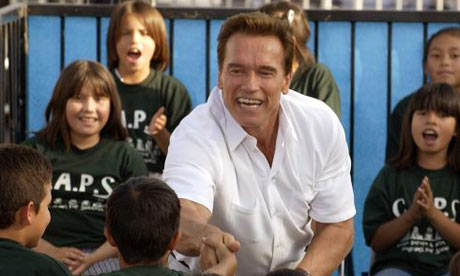
ArnoldIt looks like I'm not the only one who believes that digital books will find their first mass market penetration in the classroom. Arnold Schwarzenegger intends to give a legislative push to market evolution and obligate California schools to buy eBooks for texts, in an attempt to save the state money.
"It's nonsensical and expensive to look to traditional hard-bound books when information today is so readily available in electronic form," Schwarzenegger wrote. "Especially now, when our school districts are strapped for cash and our state budget deficit is forcing further cuts to classrooms, we must do everything we can to untie educators' hands and free up dollars so that schools can do more with fewer resources."


The devil is in the details, they say, and I'm sure many jurisdictions will be watching to see if the Governator actually saves the state money. If he does, you can be sure that there will be many imitators. It goes to show that hard times tend to stimulate innovation, as the status quo becomes too uncomfortable to maintain.

I am cautiously favourable. I've thought for some time that the textbook industry was abusive of students, both in terms of expense and of weight, and if there's a practical way to change that - and if publishers are farsighted enough to embrace change willingly - this could turn into a win-win situation. If I were a smaller publisher of textbooks, I would be rushing to see if I could jump in ahead of the big boys and gobble up a significant part of the market ahead of them.

What do you think? Is Schwarzenegger visionary or deluded? Will the peripheral costs erase the financial benefits?
 

blogger templates | Make Money Online