Monday, 21 July 2008

The Alchemy of Stone - a book review

Ekaterina SediaThe Alchemy of Stone was my introduction to steampunk and a very enjoyable introduction it was too. Ekaterina Sedia writes beautifully and there is a kind of wistful sadness to this book that did not at all fit my preconceived notion of what steampunk was. But then again, it is probably unique to this particular novel.

The Alchemy of Stone is the story of Mattie, a liberated sentient automaton (with built-in hoop skirts!) who earns her living as an alchemist, a calling that is a weird blend of magician and scientist. She feels her non-humanness acutely, not like Pinocchio longing to be a "real" boy, but wanting to be accepted for what she is. It is a lyrical, haunting story of what it means to be marginal, especially in a time of social upheaval. For revolution is brewing...

As befits steampunk, the world in which Mattie lives is roughly reminiscent of Victorian society, but it does not correspond to any identifiable time or place that actually exists. Living gargoyles, sentient automatons, slave labour, and mistreated orphans all rub elbows in this strange place. One of Mattie's strengths, and therefore one of the book's strengths, is her willingness to consider things from all points of view, and her almost total lack of prejudice. This is not to say that she is entirely objective, for she has emotions, knows pleasure and pain, joy and sorrow. She does commit to a side, both in her personal life and in the revolution and must pay the price.

I recommend The Alchemy of Stone highly. Ekaterina Sedia is an author to watch, and I will be checking out her other books.

Thanks to Larry of the OF Blog, who hosted a giveaway of a signed ARC of the book, and of course, to Ekaterina herself, who graciously sent it.)


Technorati tags: , ,

Wednesday, 4 June 2008

The Visitor - movie review

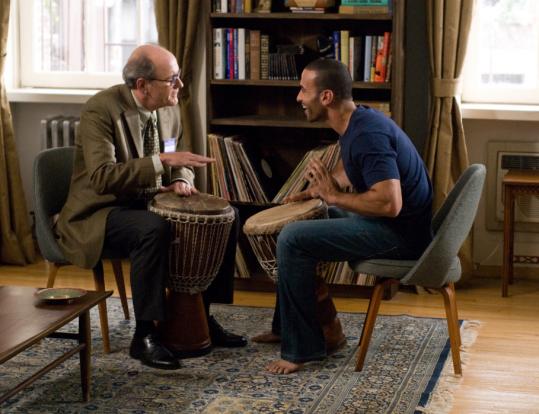
Tom McCarthy's The Visitor is a gem, a tribute to the power of understatement. It is the story of Walter Vale, a professor who has withdrawn from life to the point of being almost catatonic. When he finds his seldom-used New York City apartment inhaibited by a young immigrant couple, victims of a con artist who rented it out to them, he takes pity on them and allows them to stay. The young man, Tarek, is everything Walter is not: vibrant, passionate, full of enthusiasm and energy. They connect through their love of music and Walter is, bit by bit, drawn back into life. And then disaster strikes.

Richard Jenkins and Haaz Sleiman
This is a subtle and immensely moving story, told with restraint and dignity. Even the simplest of gestures resonates. Actors Richard Jenkins, Haaz Sleiman, Hiam Abbass, and Danai Gurira never strike a false note, conveying powerful emotions without sliding into melodrama. The social commentary of the last part of the story is obvious, but it doesn't run away with the movie, leaving it primarily a story about the characters.

If Hollywood could make a habit of producing movies of this quality, I would be in movie theatres more often. I will probably buy the DVD when it comes out, as this is a film I will be happy to see many times.


Technorati tags: , ,

Friday, 23 May 2008

In Praise of Weddings

WeddingWe have a wedding coming up. While the young couple about to marry is wildly, ecstatically happy about getting married, they keep on moaning that they should have eloped. All the minutiae of wedding planning is driving them crazy, even though they are having a relatively simple, low-key wedding.

I sympathize. But I am glad that they're going through with the hassle and bother anyway. I think it's a very important thing, for them and perhaps even more for the rest of us.

Marriage is undervalued nowadays. It truly is the central institution of a society (perhaps the only institution that is present in every human society in one form or another). And it is a good thing that we take the time to show our solidarity toward anyone committing to it.

There is nothing silly about the tradition of showers, for example. While some of the little games might be, a group of women (and sometimes men) coming together to help set up a new household reminds me of the old barnraisers - a concrete way for the community to lend a hand. There is a group of ladies in our church that think it so important that they show up, presents in hand, to every shower hosted at our church (and it's a big church). And if nobody else does, they'll host the shower themselves. It's a small ministry that most of the church is probably unaware of, but a beautiful one.

The act of physically showing up at the wedding to witness and support the vows is yet another affirmation of their importance. And yes, the gifts too are important, both practically and symbolically.

All the planning and headaches are good for the couple too. It helps cement in their minds that this a major commitment, not to be entered into lightly, and not to be left lightly. So when they moan, I sympathize, smile, and tell them that I'm glad they're doing it anyway. How important it all is might not sink in until they're marrying off their own, but that's OK. Then maybe they will realize that they were doing much more than providing an opportunity for a family get-together.

Technorati tags:

Thursday, 22 May 2008

Sanity in the Supreme Court

Supreme CourtThe Supreme Court of Canada has ruled that Waddah (Martin) Mustapha is not entitled to damages for psychological damages as a result of seeing a fly in his unopened bottle of drinking water.

I have long been amazed at what trivialities courts consider worthy of hefty damages, although amazed is perhaps too nice a word.
In a 9-0 ruling issued Thursday, the Supreme Court decided that his reaction was exaggerated and that a "person of normal fortitude, a more reasonable person, would have had a more reasonable reaction," the CBC's Rosemary Barton reported from Ottawa.

"[The court ruled] it would have been impossible for Culligan Canada, the supplier of the water bottle, to foresee this sort of extreme reaction that Waddah Mustapha had," Barton said.

The court decided the psychological damages suffered by Mustapha were "too remote" to justify more than $300,000 in compensation Mustapha was seeking, and ordered him to pay the company's court costs.

In this precedent-setting ruling, the Supreme Court has effectively and unanimously declared that psychological damage has to be foreseeable before someone can be held accountable for inflicting it.

A few more rulings like this and perhaps our legal system will actually speed up as the backlog of trivial cases is cleared out and genuinely important cases have a little breathing room.

Technorati tags: ,

Wednesday, 21 May 2008

I Can Has Cheezburger

LOLCats

This blog has become a daily stop for me. And it's too good not to pass on. I Can Has Cheezburger is a cooperative blog that allows readers to submit captioned pictures in the LOLCats tradition. Other animals or amusing pictures are accepted; the current front page has a lioness, a polar bear and a raccoon, in addition to the numerous pussycats. Several pictures are posted daily.

LOLCatz

It's like the comics page in the newspaper, but often better.

Technorati tags:

Saturday, 17 May 2008

Prince Caspian - a movie review

Chronicles of Narnia: Prince Caspian movieIn a word: meh. Warning: spoilers follow.

This is a fairly mindless action flick, I'm afraid. A mediocre one, liberally sprinkled with charming moments. The real point of the book, which is the conflict between belief and disbelief, between faith and unbelief, is almost completely buried and allowed to surface only briefly here and there to keep the lovers of the original happy. Trumpkin's personal journey from cheerful skeptic to sturdy believer is so glossed over it loses all its resonance and power to move. (I also missed the cheerfulness of the book's Trumpkin. The movie version is too melancholy to smile, although thankfully still with enough spirit to deliver a zinger or two.) Having removed the psychological motor of the story, the screenwriters tried to replace it with cheap tricks: an improperly developed power struggle between Peter and Caspian (oh please, if you're going to introduce new elements, at least do it right), a spark of romantic interest between Caspian and Susan (which they both relinquish far too easily) and Peter's anguish at having to sacrifice soldiers in the unsuccessful attack on Miraz's castle (yes, you're right, that wasn't in the book). This last one illustrates everything that was wrong with the movie. In an attempt to reintroduce depth, cheap tricks are used half-heartedly. Peter's anguish comes from nowhere and leads to nowhere. It's a throw-away moment and develops nothing. Both Caspian and Peter play with the idea of calling in the White Witch and are rescued from themselves by others. Again, it came from nowhere and led nowhere, is explained nowhere and explains nothing itself. Cheap, cheap, cheap. When Caspian proposes a duel with Miraz, it falls to Peter with no explanation whatsoever of why that should be. Again, cheap and poorly thought out.

The charming moments were almost entirely lifted from the original text of the book although Reepicheep and Trumpkin both get a couple of good original lines. The fate of the cat in Miraz's castle provided one of the good laughs. (I'm not going to spoil everything here.)

Visually, the movie is a treat and the special effects work very well.

One had to wonder at the decision to cast the Telmarines as Spaniards, both in their style of dress and armour, and in their accents. All the more amusing, since so many of them were played by Italians. It was an unexpected, but defensible decision.

Still, I can't help but mourn C.S. Lewis's spirited attack on modernity, perhaps best exemplified by the trashing of the schools as centres of indoctrination. Needless to say, this didn't make it into the movie. The central theme of the book was completely excised from the movie. What was left was moderately entertaining on a superficial level, but breaks down rather quickly on examination.

I'll probably watch the movie one more time when it comes out on DVD, just to catch the lines I missed (especially the one that everybody else laughed at). I doubt I will have any desire to see it again after that.

ETA: You can find a somewhat less snarky review here, which manages to find some good things to say (which I happen to agree with) even while pointing out even more problems.

Technorati tags: , ,

Thursday, 15 May 2008

City of God: A Novel - a review

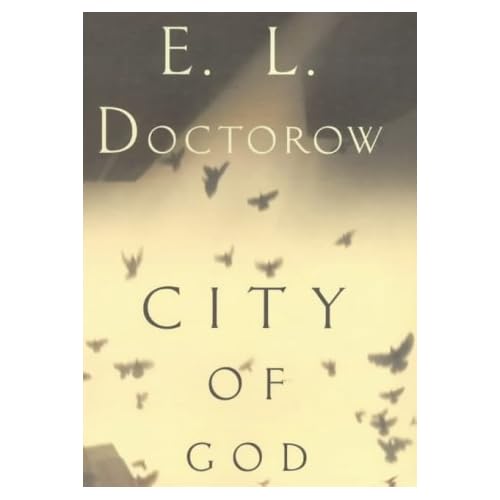
City of God - E.L. DoctorowCity of God is a fragmented, dissonant, self-absorbed, and self-referential piece of post-modernist twaddle. Written by someone with real talent. It was only the fact that I had publicly committed to reading the book as part of the 1% Well-Read Challenge that kept me from abandoning it fairly early on in the game, despite the talent and the beautiful language.

The book is essentially a modern cry of despair, the logical conclusion of a worldview essentially wrapped up in self. Everett, the author whose words we are supposedly reading, has this to say about himself. (Or was it his fictitious alter-ego? I forget. It's very hard to keep track of who is speaking sometimes.)
So he is lean, fit, he takes very good care of himself in that way of someone profoundly faithless. He runs, works out almost religiously, for the self-maintenance that is his due.

The main object of his attention is Tom Pemberton, a maverick Episcopal priest who is supposedly seeking to find out who God really is, but who is equally self-absorbed. Witness his take on prayer:
You should try it. As an act of self-dramatization, it can't be beat. You get a hum, a reverberant hum of the possibility of your own consequential voice.

He calls his skull his cathedral, appropriate imagery for several reasons.

The plot, if you can call it that, is highly fragmented, told from various viewpoints, all presumably written by the fictitious author, and is really a series of different stories and metaphysical ramblings, interspersed with an adult version of teen angst poetry, riffing off of some of the classic songs of the early 20th century. A few little ornithological observations are thrown in for a reason which would probably become clear if I reread the book and spent a few hours meditating on its symbolism. (And please, Mr. Doctorow, it's not Canadian geese, it's Canada geese.)

The voice is well-done. Doctorow has a deft way with the language and occasionally throws out a flash of insight that delights. But there are a large number of viewpoint characters, most speaking in the first person, and almost all of them sound alike. This is sloppy characterization and makes it even harder to fit together the shards of story that make up City of God.

All in all, I found this a highly irritating book. From the pretentious arrogance of much of the metaphysical ramblings (I get very annoyed when affirmations of opinion are presented as logical necessities, when they are anything but), to the disjointed "story-telling", to the essentially unsympathetic characters, too much of this book was designed to grate on my nerves, so that its virtues just weren't enough to win me over.

Doctorow has won plenty of awards for his work, so obviously plenty of people disagree with me. I do note, however, that City of God appears to be one of his least popular books as rated by Amazon reviewers.

Technorati tags: ,

Tuesday, 13 May 2008

The General has a point

Roméo DallaireGeneral Roméo Dallaire (that's Senator Dallaire to you civvies) is upbraiding the Conservative government over the case of Omar Khadr. (In all fairness, the Liberals didn't do any better when they were in power, which may be why Stéphane Dion is threatening to discipline the senator, in yet another stunning example of Dion's lack of political and good sense.)

Dallaire's central point - and whatever you think of the General or Khadr or any of the political parties, it's a very good one - is that Khadr was only 15 at the time he was taken into custody and sent to Guantanamo. Someone that young is normally considered a victim of indoctrination and/or intimidation and is rehabilitated, not charged. He asks what makes this case different. And he's right. You cannot have two sets of standards, applied according to the political winds of the times. Either we stand for human rights and justice equally applied, or we don't.

Dallaire said Canadian soldiers have helped rehabilitate more than 7,000 child soldiers in Afghanistan. None of them have been prosecuted, he said.

"What is the political reason? What makes [Khadr] different from the others?" said Dallaire.


Technorati tags: ,

Wednesday, 7 May 2008

Quote of the day - evangelicals in academia

Michael Lindsay
"Evangelicals are the most discussed but least understood group in American society. Observers often assume that they are in lockstep with the Republican Party, but the sociologist Christian Smith has shown that 70 percent of evangelicals do not identify with the religious right. Other observers conclude that evangelicals principally serve their own interests, but Allen D. Hertzke's persuasive Freeing God's Children: The Unlikely Alliance for Global Human Rights (Rowman and Littlefield, 2004) shows that evangelicals work as vigorously to protect the religious freedom of Buddhists and Jews around the world as they do that of their fellow Christians. A number of journalists and pundits have written about evangelicals since 2000, but the most interesting and helpful works have been academic studies based on empirical research. (Pick up one of those instead of a best-selling polemic to learn more about the subject. Hint: Avoid any work that includes "theocracy" in the title.)"


From "Evangelicalism Rebounds in Academe" (subscription necessary) by sociologist Michael Lindsay in The Chronicle of Higher Education.

The article discusses the increasing presence of evangelicals in the academic community and challenges many cherished misconceptions.


Technorati tags: , ,

Saturday, 3 May 2008

The 1% Well-Read Challenge

1% Well-Read ChallengeBook lovers of the world, unite!

Peter Boxall's book, 1001 Books You Must Read Before You Die, is the basis of a challenge that is being thrown out by Michelle of 1morechapter.com. To accept this challenge, you commit to read 1% of the list over the next 10 months, which is one book a month. She even refers us to a nifty spreadsheet that allows you to tick off all the books you've read and get an automatic calculation of how many you need to read a month to get them all in before you die. I would have to read three a month. Not going to happen. Reading three books a month is not the issue; I just have too many books outside of that list I want to read.

But there were so many books on this list that I really wanted to read anyway, I figured I'd officially throw my hat in the ring.

The 10 books (subject to change) I have selected for this challenge are:

City of God - E.L. Doctorow
A Prayer for Owen Meany - John Irving
Beloved - Toni Morrison
Do Androids Dream of Electric Sheep - Philip K. Dick
The Golden Notebook - Doris Lessing
The Grapes of Wrath - John Steinbeck
Their Eyes Were Watching God - Zora Neale Hurston
The Magic Mountain - Thomas Mann
The Moonstone - Wilkie Collins
The Betrothed - Alessandro Manzoni


Technorati tags: ,
 

blogger templates | Make Money Online